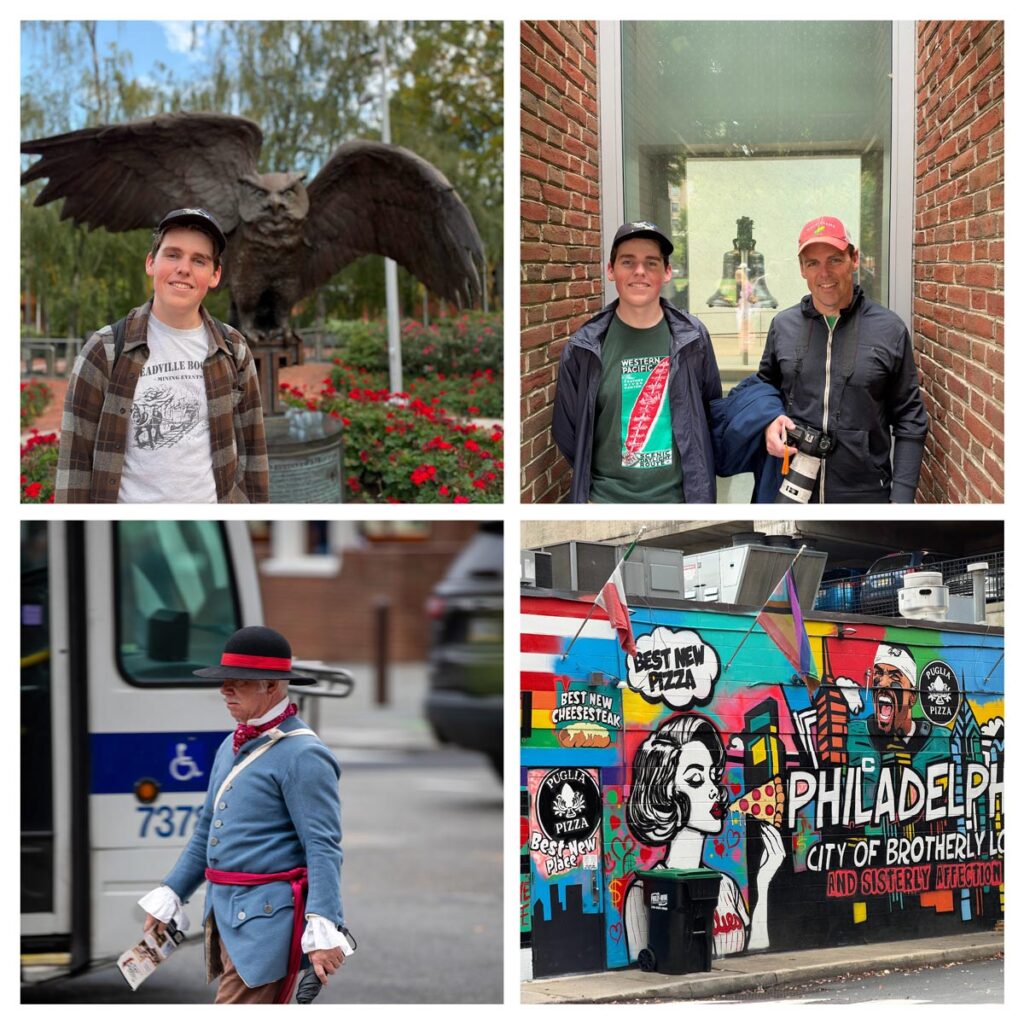
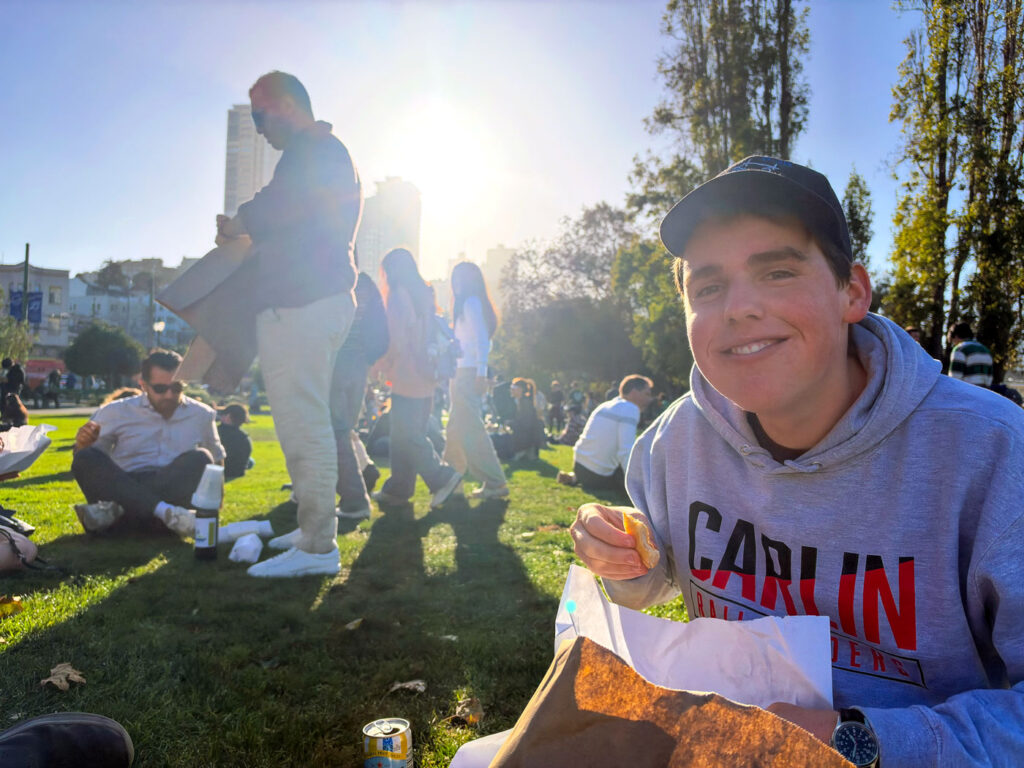
Last week Hen & I journeyed out to Philadelphia & then Washington, DC to check out a variety of schools—and snacks. 🙂
On Thursday we started out at Temple University (home of the Owls!), where Hen may want to study architectural preservation. We tucked into a famous Philly cheesesteak that eve, before washing it down with another on Friday ahead of our campus tour. In the meantime we checked out the Liberty Bell.
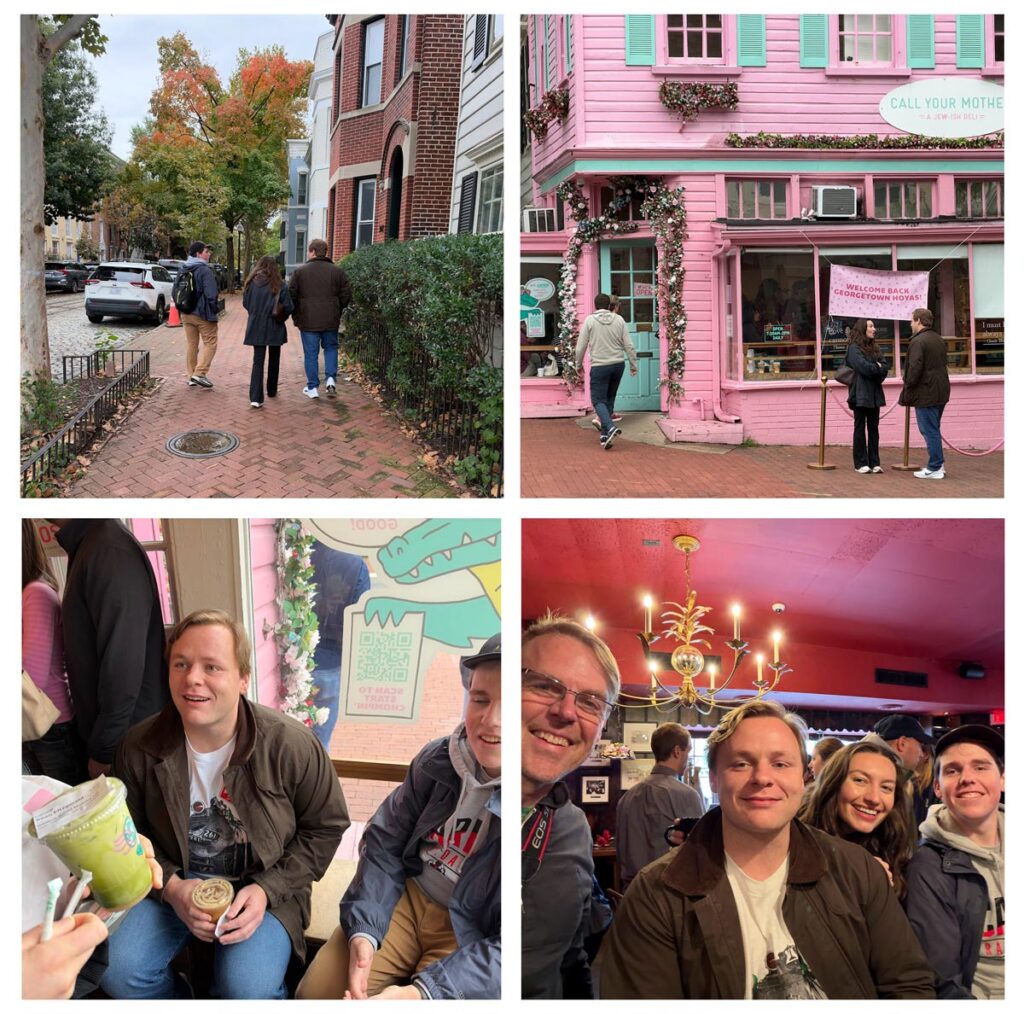
After touring Temple, we hopped on Amtrak to Washington, where we marveled at Union Station, knocked back burgers at an Irish cop bar, and zoomed off to Alexandria. Ken Burns was our constant companion, delighting us with his iconic Civil War documentary.
The next morning we walked across the Potomac to Georgetown, where we met up for bagels with Isabella Murray & her boyfriend Sean, who’s great! He later hooked us up with his “Cheesesteak Safari” recommendations, which we were all too happy to take.
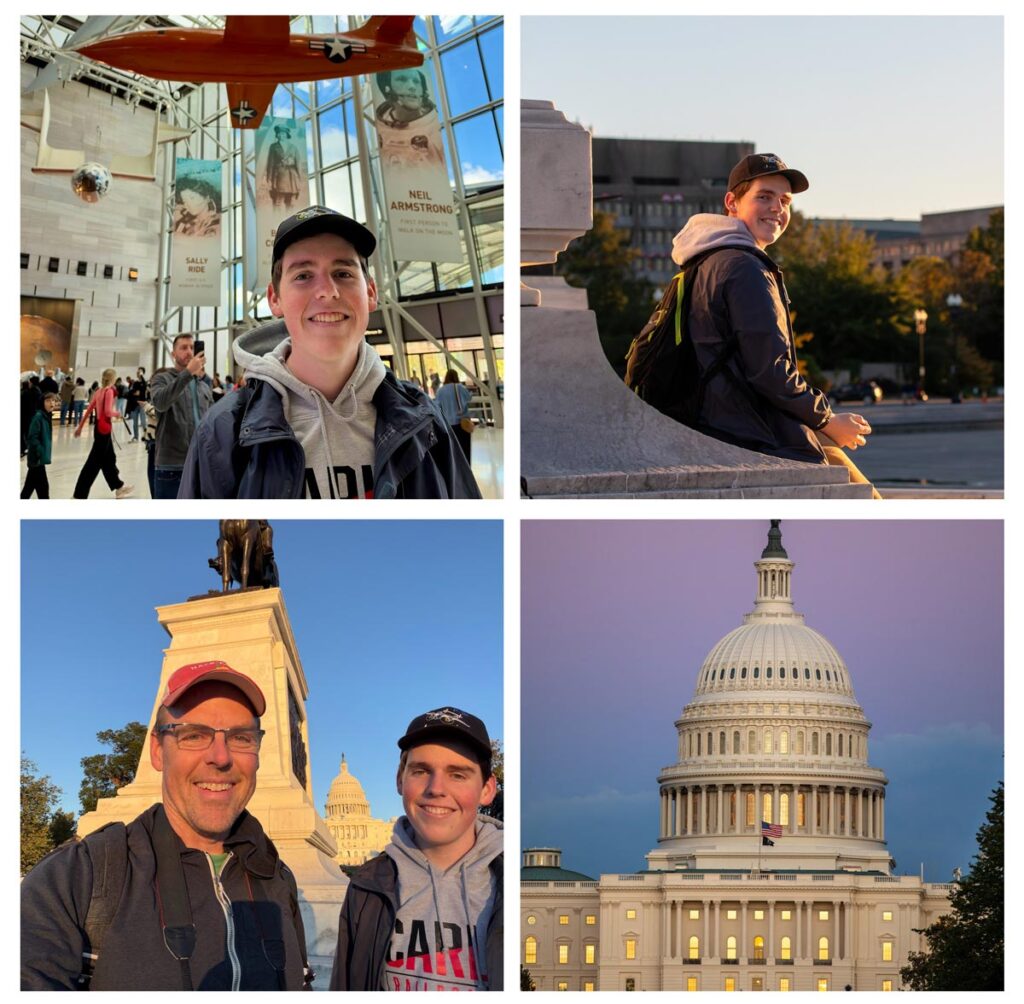
Following our tour of chilly Georgetown, we walked & walked—first around the Air & Space Museum with Hen’s Oxford pal Zev (bringing back happy memories of touring it with my cousins & folks in the 80’s), then up and down the Mall, to the Capitol & Washington Monument and points beyond—9 miles in total!
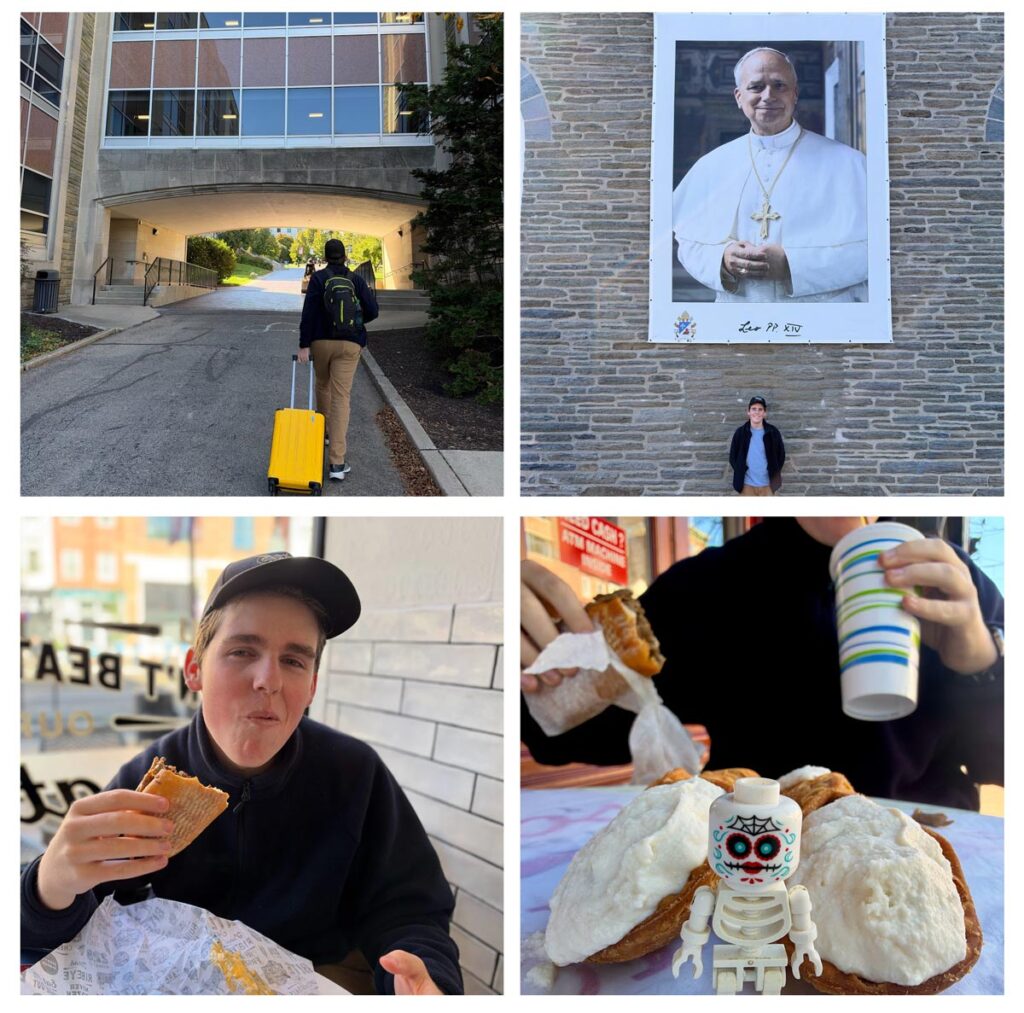
Having hopped a late-night train back to Philly, we got up on Sunday, bit Temple farewell, and took yet another train out to Villanova. Hen immediately fell in love with the Pope’s alma mater: “This feels like a place where I could make great friends.” He’s probably finishing his application essay as I write this!
Having zipped back to Philly, we rounded out our journey (and bellies) with yet more cheesesteaks, then lolled our way onto the plane for our trip home. Check out our full photo gallery for all the sights!
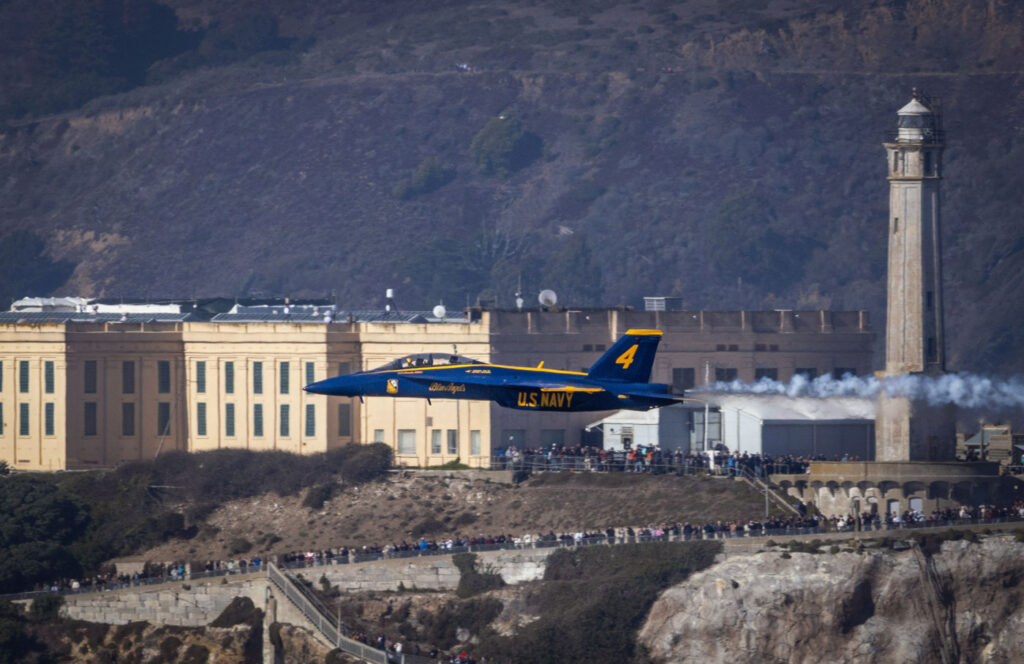
Much as we did in 2022 and then again in ’24, Henry & I delighted in witnessing the Blue Angels streaking over San Francisco.
This year, acting on a hot tip from Hen’s fellow plane-nerd friend Grace, we headed up (and up, and up) to SF’s Norwegian Seamen’s Church. We met up with Grace and enjoyed a unique Alcatraz’s-eye view of the festivities:
I (very slightly grudgingly) surrendered my big lens to Henry, but I too was able to get some fun shots with the shorter one. Check out the gallery we made together!
Afterwards we walked even more, making our way to North Beach to meet up with our visiting friend Matt, his son, and some restorative cannolis. Check out some additional pics.
Attending Bellarmine’s annual Solidarity Night, we were so proud to hear Henry reflecting on this past summer’s service trip to El Salvador. He’s always had a huge heart, and we loved hearing his reflections on the eye-opening sights and stories he encountered. Here’s the recording:
And in case the audio is challenging to decipher, here’s the text of Hen’s remarks:
———–
Hi, my name is Henry Nack. When I first stepped off the plane in El Salvador, I had no idea what to expect. Ten days in a foreign country with 9 guys I didn’t know, going to some of the most important and powerful sites in the entire country. The question that stuck in my mind was: Who would I become after this? I continued to reflect on this question during the trip and even now as I share this speech with you, weighing its impact on me.
Part of the El Salvador immersion trip focuses on the Civil War, which occurred from roughly 1979 to 1991. During the civil war, thousands of people were killed, families were torn apart, and the population endured tremendous oppression and violence. On our trip, we spent a day visiting El Mozote, a site where over 1,000 civilians were killed by the Salvadoran government. This massacre was carried out by the Atlacatl battallion who were trained in the US and were armed with American made weapons, paid for by American taxpayers. After a 5 hour drive the day before, and a brief drive through the jungle, we arrived in El Mozote. What immediately struck me was how normal the town looked, like any other in the country. It had a main square with a church, there were people making pupusas, and people walked through the town casually. If a person didn’t see the monument, they could never know what had happened there.
When we arrived at the monument, our guide Felipe explained to us exactly what had happened and how the people were killed. Then, after hearing this he gave us time to enter the church garden, which memorializes all the children and infants killed in the massacre. I read name after name of those that were lost, many with the number zero listed after their name, indicating they had not even reached their first birthday. It was difficult to imagine that the exact place where we were standing had so much suffering occur there. As I stood there and reflected on what had happened, I couldn’t understand how you could possibly do this to another person? How could someone set aside their humanity and do such an awful thing? These are not easy questions and honestly, I didn’t want to think about them because they were deeply uncomfortable questions. But as this experience continued to unfold, they stuck with me.
As we continued on in the town, we came across one of the last tangible physical remnants of the massacre, a single dilapidated wall with bullet holes in the plaster. The wall was falling apart and covered in vines, and was scheduled to be demolished to make way for new construction. That wall, though it may have been considered an eyesore, was more powerful than any modern museum or plaque could ever be. It’s one thing to read a name on the wall, but seeing a wall with its bullet holes which bears witness to the pain and reality of what happened is another things. As Felipe told us about this wall, he also mentioned that some government officials wanted to have it removed. And as I wrestled with this question of how this could possibly happen, I began to realize if we tear down these reminders and avoid these questions we are running away from what happened. It may just seem like an old wall, but what it’s a marker of the truth of all that happened that day.
I continued to think about what I had saw and and what had happened through the remainer of the trip. But the last day, we visited a base community there called communidad, Dios en Camino or God of the journey. While visiting this community, I had a realization while looking at a mural of the map of El Salvador with all its different regions, and in almost every region marked a different massacre, massacres that I hadn’t even heard of. I felt overwhelmed staring at it and I realized this isn’t something that just happened in El Mozote, but it happened all over El Salvador. The question was not how this could happen once, but how could this happen again and again, and again? And I realized that these moments of great suffering don’t just happen in El Salvador, but they happen all over the world too. So what am I supposed to do with that? How can these questions just keep building?
At Dios En Camino, there were large photos of a lot of the martyrs in one of the rooms. While I was looking at them, one of the women shared about her encounters with the laypeople and priests who had been martyred during the war, including St. Oscar Romero. The way she talked about them made me realize that they weren’t just these perfect, powerful figureheads. They were real, imperfect people who answered God’s call to go serve. They weren’t really so different from me or you.
We have to keep asking those difficult questions about the past, because justice isn’t comfortable or easy. It’s easy to just not think about what happened, do nothing, to shy away from those questions, but if we do that, we let injustice win. If we don’t actively work toward justice, then we just slide the other way without even realizing it. The martyrs, everyone working for justice today, kept on asking those questions, even though they knew it was dangerous. They kept working on problems that felt too large for one person to respond to. It wasn’t easy then and it isn’t easy now, but that doesn’t matter. Justice is what matters.
Before going to El Salvador, I wondered who I would become afterward. Now, I know. I want to spend my life serving those who need it. I want to listen to God’s call, like the martyrs did. For me, faith and service are one and the same. I want to strengthen my faith by being of service to my neighbors, my fellow human beings. Everyone deserves justice, and if I can help with that, I will do everything I can to do so. Thank you.